


The ambition to open a restaurant in Dubai often comes up against the fear of an opaque and risky administrative process for your capital. This practical guide methodically details the licensing procedures and the strategic choices that need to be made in order to validate your project with the local authorities. Access the keys to setting up a successful business and avoid the costly mistakes that await ill-prepared entrepreneurs.
Before you launch: concept and business plan
Dubai is a restaurant Eldorado, that's a fact. But improvisation is a sure recipe for financial disaster. Even before you think about decoration, the first stage remains pure strategy.
Adapting your offering to the Dubai market
Thinking that a copy and paste of your French success will work here is a costly mistake. You're facing a a complex cosmopolitan mix of expatriates, tourists and discerning locals. A third of residents eat out several times a week, constantly looking for something new.
Your menu cannot remain static, adapting the menu is vital. Veganism, for example, is not a passing fad but a demand, as the example of Veganity shows. Innovation is appreciated and expected.
You also need to adapt your schedules and marketing to local customs, particularly during Ramadan. This is an incredibly dynamic market, but it does not forgive amateurism.
The business plan: more than a document, a strategy
Stop seeing the business plan as a chore for the bank. It's a your real roadmap to open a restaurant in Dubai without crashing. Without it, you're sailing blind.
This file must be surgical: precise concept, concrete market research, financial forecasts and marketing strategy. It serves to prove the viability of your project before incurring any costs.
In any case, the authorities and your future partners will demand it. A solid plan is your only guarantee of seriousness to investors.
Choosing the right location: a crucial decision
Location often decides whether you survive or fail. Visibility, footfall and proximity to your target are well worth a higher rent. A poor address will kill your sales.
An expert tip: look for premises that have already been used as a restaurant. This drastically simplifies technical approvals from the Dubai Municipality (DM). Leaving a new premises will require a lot more work and patience.
The administrative route: structure and licences
Once the concept and the location have been validated, it's time to jump in. the administrative arena. This is where things get tricky, and where support comes into its own.
Mainland vs free zone: the comparison for a restaurant
You have two main routes for setting up a business in Dubai: the Mainland or the Free Zone. It's not just a technicality, it's a fact of life. what defines your real access to the market.
For a restaurant owner who wants to serve both locals and tourists, the Mainland is often a must. The Free Zone? Save it for a central kitchen or if you only deliver.
The Mainland offers total geographical freedom. Before, you needed a sponsor, but now.., the foreign 100% property is the standard for many, even if a Local Service Agent (LSA) sometimes remains in the background during the choice between Mainland and Free Zone.
| Features | Mainland | Free Zone |
|---|---|---|
| Property | 100% foreign possible (often with LSA) | 100% foreign |
| Target market | Direct access to the entire UAE market | Activity limited to the free zone and internationally (except via distributor) |
| Location | All over Dubai | Only in the designated free zone |
| Ideal for... | Restaurants, cafés, retail outlets | Central kitchens, trading, B2B services |
The two basic licences to be obtained
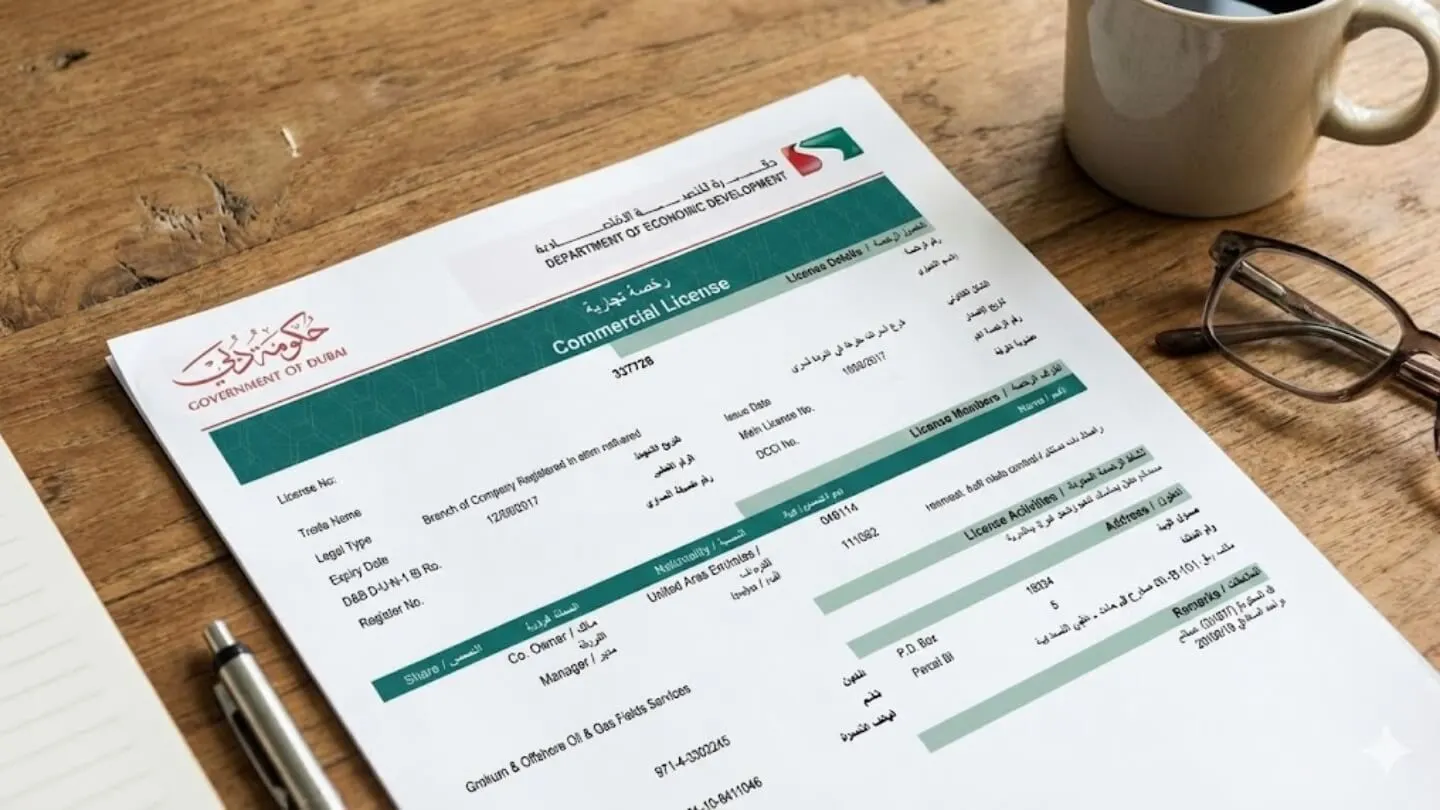
You won't be moving without two compulsory passes. The first is the commercial licence, issued by the Dubai Department of Economy and Tourism (DET). It is your licence to exist legally.
Then you have to convince the local authority's Food Safety Department. It is this Food Licence that validate that your kitchen won't poison anyone and complies with standards.
The classic mistake? Thinking that you can do them in parallel. Without the DET's initial green light, the food licence remains a distant dream. It's a rigid domino game.
- Obtain initial approval from the DET and reserve the trade name.
- Signing and registering the commercial lease (EJARI).
- Submitting documents for registration and obtain a temporary commercial licence.
- Obtain approval for the plans for the premises from the Dubai municipality and pass the final inspection for the food licence.
Legal structure: llc, sole establishment or civil company?
Let's talk about asset protection. The LLC (Limited Liability Company) is the standard way to get a good night's sleep. It protect your personal assets, Even if the entry fee for certain concepts can sting.
There are other options, such as the Sole Establishment for lone wolves or the Civil Company. It seems simpler for partners to start up, but beware of the backlash.
What's the catch? With these shapes, your liability is unlimited. If anything goes wrong, you pay out of your own funds. In addition, a Local Service Agent (LSA) will often be required.
ACCOMPANIES YOU


+ 500 companies
Already have confidence in us
The budget: anticipating costs to get off to a good start
Paperwork costs money. Now that the legal framework is in place, let's talk money. Proper budgeting is the only way to avoid unpleasant surprises.
Initial set-up costs explained
The amount fluctuates, but a the administrative costs base remains incompressible. This is your ticket to entry, and you need to plan ahead to avoid financial suffocation.
Expect to pay around AED 18,260 for pure administrative procedures, excluding rent. This is the the bare minimum for legal existence.
Approvals, solicitors, taxes: the bills are piling up. With expert help, you can rationalise these outputs and avoid costly errors which are a drain on cash flow.
- Initial approval fee : The first ticket.
- Reserving a trade name : A fixed cost to be expected.
- Notary fees for articles of association.
- Cost of the annual commercial licence : Approximately 10,000 AED, the largest item.
- Immigration card fee (Establishment Card).
- Cost of an investor visa Approximately 4,250 AED for 3 years.
Beyond licences: other expenditure items
Beware, the administrative side of things is just the tip of the iceberg. The rent (EJARI), which is often payable on a yearly basis, weighs heavily, as does the cost of living in Dubai on your overall budget.
Add fit-out, kitchen equipment, initial stock and marketing, essential for attracting your first customers.
The business bank account stage
Bachelor's degree in hand? Make way for’opening a business bank account. This is a legal requirement, but the process is much more rigid and demanding than in Europe.
Banks will scrutinise everything: licences, passports and business plans. Please note that the physical presence of the manager is almost always required to complete the opening.
From paperwork to plate: compliance and operations
The money has been set aside and the licences are in hand. Now it's time to get down to business: make your premises operational and recruit your team. This is the final sprint before the opening.
Dubai municipality standards for your premises
The Dubai municipality is uncompromising. Even before any ground is broken, your architectural kitchen plans must be validated. This is a common stumbling block for the uninitiated.
Everything is controlled: sufficient storage space, effective ventilation, waste management and drainage systems. Every detail counts and nothing is left to chance.
The final inspection of the premises determines the issuing a food licence. There's no room for compromise: it's a prerequisite for opening.
Additional permits: alcohol, shisha and other specificities
Boosting your sales with additional services is tempting, but each option requires a specific licence. This adds a layer of administrative complexity often underestimated.
These procedures, which are separate from the main licence, meet strict criteria. Here is the most common licences to anticipate :
- Alcohol licence Issued by the Dubai Police and the DTCM, highly regulated.
- Shisha licence : Subject to strict size and location conditions.
- Permits for pork products : Requires a separate storage and preparation area.
- Authorization for an outdoor sign : Necessary if it differs from the official trade name.
- NOC for food trucks : An RTA permit is required for each location.
Managing your team: work visas and training
Don't underestimate the HR aspect. Every foreign employee requires a work visa sponsored by your company. This is a administrative procedure in its own right which requires rigorous anticipation.
In addition, food safety training is compulsory for kitchen staff. Complying with employment law and the post-creation stages of your company is non-negotiable if you want to ensure the long-term future of your business.
Opening a restaurant in Dubai offers immense opportunities, provided you master the administrative machinery. Between compulsory licences and strict health standards, there's no room for improvisation. Meticulous preparation and expert guidance are your best trump cards for turning this complex process into a success. sustainable commercial success.
Avoid the pitfalls and maximise your chances of success
The classic mistake: believing that residency is automatic
Many people think that opening a business offers them a visa on a silver platter. But this is not the case. Setting up a company is a necessary technical condition, of course, but it also is still not sufficient to obtain residency.
Don't be naive: this visa is never «guaranteed» by default. Your application must be formally approved by the immigration authorities, who will check that your file is fully compliant. A criminal record that is not clean, for example, will result in a immediate refusal.
In short, it's a a potential route of access, not an automatic right. Absolute rigour is the key to success.
Choosing the right business and location: decisions not to be taken lightly
I would warn you: choosing an activity or area solely for its low price is a mistake. dangerous strategy. It's a short-term vision that often ends up costing you a lot of money.
The activity declared on your licence must correspond exactly to what you actually do on a daily basis. A discrepancy can lead to heavy financial penalties and seriously complicate future renewals licence and visa.
Similarly, the choice of freezone is not insignificant. Some freezones are specialised and are much better perceived by banks or partners. Visit our guide to setting up a company in the Emirates for avoid the worst.
The importance of support from local experts
Let's stress one point: wanting to do everything on your own to save money is often a mistake. miscalculation. Regulations change quickly and there are far too many local subtleties to ignore without risk.
Call on experts in setting up a company in Dubai, such as Clemenceau Group, allows you to securing the process from A to Z. This will help you avoid costly mistakes and save you precious time when you're ready to launch.
It's a real investing in peace of mind and efficiency your expatriation project.
Get your residence via business creation offers unique stability and an exceptional tax environment in the Emirates. More than just a formality, it's a genuine strategic choice for your future. With careful preparation and the right partners, this opportunity becomes a real opportunity. a decisive springboard for your international development.
Frequently asked questions :
What are the key stages in opening a restaurant in Dubai?
Opening requires a methodical approach: start by validating your concept and signing the lease for a commercial premises (EJARI), preferably already fitted out as a restaurant. Next, you need to obtain initial approval from the DET for your business licence, and then get the layout of your kitchen approved by the Dubai Municipality to get the essential food licence.
What budget should you set aside to launch your restaurant in Dubai?
The initial investment depends on your ambitions. Administrative and licensing costs generally range from AED 25,000 to AED 100,000. For the overall budget including fittings and equipment, For a standard restaurant, expect to pay between AED 400,000 and AED 800,000, while a gourmet establishment will often cost over a million dirhams.
Is the restaurant business profitable in Dubai?
Yes, the potential is enormous, thanks to the cosmopolitan and tourist clientele who regularly visit the restaurants. However, it's not enough, profitability is not automatic It requires a strong concept, a strategic location and rigorous management to stand out in a highly competitive market.
Can a foreigner own a 100 % restaurant in Dubai?
Exactly. It is now possible for a foreign investor to hold 100 % of shares in his restaurant, even in the Mainland (on the local market). Although a Local Service Agent (LSA) may be required to help with administrative formalities, depending on the legal form, he or she is not involved in the ownership of the company.