


Are you planning to settle in or travel to the United Arab Emirates and wondering what currency is used in Dubai? The UAE dirham, identified by the international code AED, is the official currency of the entire federation. Understanding how it works, its exchange rate against the euro and the best strategies for managing your money in the country is an essential prerequisite for any entrepreneur or expatriate looking to optimise their spending.
This guide details everything you need to know about currency in Dubai: from the history of the dirham to practical tips on how to change your euros at the best rate, not forgetting the methods of payment accepted in the emirate.
The UAE dirham: Dubai's official currency
The UAE dirham (AED) is the currency of the seven emirates, including Dubai, Abu Dhabi, Sharjah and Ras Al Khaimah. Adopted in 1973 to replace the riyal of Qatar and Dubai, the dirham quickly established itself as a stable, internationally recognised currency. Its ISO 4217 code is AED, short for «Arab Emirates Dirham», and its local symbol is written د.إ or more commonly Dh and Dhs.
One dirham is subdivided into 100 fils, although these small units are used less and less in daily transactions. The Central Bank of the United Arab Emirates is the institution responsible for issuing and regulating currency throughout the federal territory.
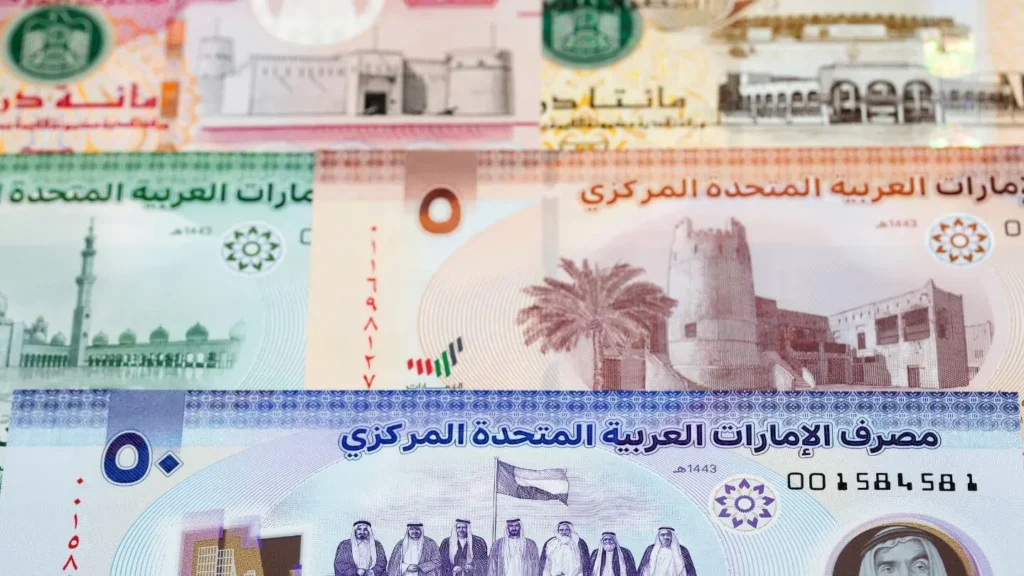
Banknotes and coins in circulation
The dirham notes are available in denominations of AED 5, 10, 20, 50, 100, 200, 500 and 1,000. Each note features motifs representative of the cultural and architectural heritage of the United Arab Emirates: a falcon, a historic fort, a mosque or modern facilities. The distinctive colours make them easy to identify in everyday use.
As for coins, you will find denominations of 1 dirham, 50 fils and 25 fils. The 5- and 10-thread coins exist in theory, but have virtually disappeared from circulation. For your day-to-day spending in Dubai, AED 50 and AED 100 notes are the most practical denominations. Avoid ending up with only AED 500 or AED 1,000 notes: some small shops may refuse to give change in these larger denominations.
AED / EUR exchange rate: what you need to know
The UAE dirham has been pegged to the US dollar since 1997 at a fixed rate of AED 3.6725 per USD 1. This fixed parity gives the dirham remarkable stability, which reassures investors and entrepreneurs based in the United Arab Emirates. The exchange rate between the euro and the dirham therefore fluctuates mainly according to changes in the EUR/USD exchange rate.
In February 2026, the average exchange rate is around 1 EUR = 4.36 AED, which means that 100 dirhams is equivalent to around 22.90 euros. This rate varies slightly depending on the day and the exchange providers used. For entrepreneurs managing financial flows between France and Dubai, monitoring this exchange rate is crucial to optimising transfers and protecting margins.
Quick conversion table EUR / AED
| EUR | AED (approx.) |
| 1 € | 4.36 AED |
| 10 € | 43.60 AED |
| 50 € | 218.00 AED |
| 100 € | 436.00 AED |
| 500 € | 2,180.00 AED |
| 1 000 € | 4,360.00 AED |
These values are indicative and based on an average exchange rate. Consult an up-to-date online converter before any major transaction.
Where can I change euros into dirhams in Dubai?
There are several options for converting your euros into local currency once you're here. Currency exchange bureaus are ubiquitous in Dubai's shopping centres and tourist areas. Brands such as Al Ansari Exchange, UAE Exchange and Al Rostamani International Exchange offer competitive rates and low commissions, often much lower than those charged by European banks before you leave.
ATMs are another practical solution. They are available in almost all shopping centres, underground stations and residential areas. However, your French bank will charge a fee for withdrawals abroad, generally between 2 % and 3 % of the amount, plus a fixed fee per transaction. To minimise these costs, opt for larger, less frequent withdrawals.
If you are planning a long-term expatriation, opening a local bank account in the United Arab Emirates is the most cost-effective solution. This eliminates recurring conversion charges and allows you to receive your income directly in AED. To find out more about this key step, read our complete guide to opening a bank account in Dubai.
→ Read: Opening a bank account in Dubai
Paying by cash or credit card in Dubai?
Dubai is an extremely well-equipped city in terms of payment infrastructures. Visa and Mastercard are accepted in the vast majority of establishments: restaurants, hotels, shopping centres and even taxis. Contactless payment is widespread, and both Apple Pay and Samsung Pay work perfectly in the emirate.
However, keeping a cash reserve in dirhams remains essential for certain situations. Traditional souks, small local shops and some independent taxi drivers prefer cash. Bargaining in the souks, particularly the Gold Souk and the Spice Souk, is exclusively cash-based. Expect to budget between AED 200 and AED 500 in small denominations for these everyday purchases.
For entrepreneurs and expatriates managing business expenses, a locally-issued bank card offers the best rates and avoids the international transaction fees charged by European banks. This is a significant way of optimising your finances when your monthly expenditure in dirham reaches several thousand AED.
Strategies for managing money effectively in Dubai
The first rule is never to change your money at the airport. Exchange rates there are systematically unfavourable, with margins of up to 5 % over the average market rate. Wait until you are in the city centre to change money.
Neo-banks and international transfer services such as Wise or Revolut are particularly advantageous for expatriates. These solutions apply the real interbank exchange rate, with no hidden margin, and charge minimal conversion fees. For regular transfers between France and the United Arab Emirates, these tools can save you hundreds of euros a year compared with traditional banks.
For entrepreneurs setting up a company in Dubai, the choice of invoicing currency has a direct impact on profitability. By invoicing your local customers in AED and your international customers in euros or dollars, you can limit your exposure to exchange rate fluctuations. Good currency management is an integral part of the financial strategy of any company operating in the Emirates.
→ Read: Setting up a company in Dubai
FAQ about currency in Dubai
What is Dubai's official currency?
Dubai's official currency is the UAE dirham, identified by the code AED. It is used in all seven emirates of the federation.
How much is 1 euro worth in dirhams?
In February 2026, 1 euro will be worth around AED 4.36. This rate fluctuates daily according to the EUR/USD exchange rate, since the dirham is pegged to the US dollar.
Can I pay in euros in Dubai?
No, the euro is not accepted as a means of payment in Dubai. You must have dirhams or use an international bank card for your purchases. Some large hotels may accept euros, but the conversion rate applied will be very unfavourable.
Where can I get the best exchange rate in Dubai?
Exchange offices located in shopping centres and shopping areas generally offer the best rates. Avoid the airport and hotels. For international transfers, online platforms applying the interbank rate are still the cheapest solution.