



Between deposits blocked indefinitely and opaque administrative fees, moving to the Emirates can quickly become an unforeseen liability for your budget. This technical guide explains how to rent a car in Dubai in complete safety, You'll find objective comparisons of leasing and short-term offers for demanding entrepreneurs and expatriates. Here you can access practical methods for avoiding contractual pitfalls, controlling the real costs of the Salik system and protecting your cash flow against abusive fines.
Documents and conditions: what you really need to know
Driving licence: national or international?
For tourists French, a national licence is generally sufficient to collect the keys. Most of the major chains accept it without batting an eyelid. Just make sure it's valid. That's the basic rule.
However, I recommend that you obtain an International Driving Permit (IDP) before you leave. This is a essential safety in the face of some more rigid local agencies. Better safe than sorry at the counter.
Bear in mind that this document is only a translation. It must always accompany your original licence, never replace it. You can't have one without the other.
Minimum age and length of licence: the rules in Dubai
La bar is set at 21 years to hire a standard vehicle. You must also have held your driving licence for at least one year. This is checked systematically.
Young driver« charges often apply if you are under 25. For driving a large SUV or sports car, the required age quickly rises to 25 or even 27. Insurance companies don't play around with these criteria.
Always check this specific condition for the model in question before booking. A unpleasant surprise on arrival happened quickly.
Essential documents for tourists and residents
Here is the exact list of documents required for avoid refusals at the counter. Have these things ready before you even step through the agency door.
- For tourists: Valid passport, tourist visa (or entry stamp), national driving licence (with PCI as a backup) and a credit card in the driver's name.
- For residents : Valid Emirates ID, UAE driving licence (mandatory) and credit card in the driver's name.
For residents, driving with a foreign licence is totally illegal. Conversion to a local licence becomes compulsory as soon as you have obtained your visa and Emirates ID.
Credit or debit card: the latest on security deposits
Almost all branches require a CREDIT card for freeze the deposit. This deposit generally varies between AED 1,000 and AED 3,000. This is the market standard here.
If a branch accepts your debit card, the amount will be debited immediately, not just blocked. Repayment may then take several weeks. This risks drain your holiday budget.
Check the word «CREDIT» on your card and your available limit before you leave. This is a detail that changes everything.
Choosing your car: city car, SUV or supercar?
Now that the paperwork is clear, let's get down to business. choice of vehicle. The type of car you choose will determine not only your budget, but also your driving experience in Dubai.
City cars and hatchbacks: the smart choice for the city
Forget the ego for a moment. When it comes to navigating through heavy traffic or finding a seat at the Dubai Mall, nothing beats a Kia Picanto or a Toyota Yaris. This is the most affordable option, sometimes costing as little as AED 60 per day, making it ideal for those on a budget.
Even if it doesn't cost much to fill up here, their low fuel consumption is a major advantage in the face of distances that can be deceptive. This is the perfect utility vehicle for your daily trips to and from Jumeirah beach and the shopping centres.
Let's be honest: it's the choice of reason for those who want to explore the tarmac without venturing into the dunes.
SUVs and 4×4s: for families and adventurers
SUVs reign supreme on Sheikh Zayed Road for good reason. It is the the ideal compromise between safety and comfort to swallow up the miles of motorway, especially if you're carrying the whole family and their luggage.
Be careful, though, if your aim is a trip into the desert. a real 4×4 like a Jeep Wrangler is non-negotiable. It's essential to check that your policy allows off-road driving, otherwise your insurance won't cover you in the event of a costly breakdown.
Don't be fooled: many urban SUVs don't have four-wheel drive and will immediately get bogged down. The technical distinction is crucial here.
Luxury and sports cars: the Dubai experience
For some entrepreneurs, driving a Ferrari or Lamborghini isn't just a form of transport, it's a way of life. assertion of status. Luxury car hire is an integral part of the local lifestyle and image.
The entry fee is obviously high, often starting at over AED 500 per day for entry-level models. Expect drastic conditions too: massive deposit freeze and minimum age often raised at 25 or even 27.
It's great for enjoying yourself on the main road, but frankly impractical for real, dusty exploration of the surrounding area.
Special vehicles: minivans and group options
Travelling as a team or with a large family? Minivans like the Kia Carnival or 9-seater vans are available, but they go very quickly. It's essential that you book weeks in advance to avoid being left without a solution.
Financially, it's often much more profitable than having to hire and insure two separate small cars. What's more, the atmosphere is much nicer for long journeys to the theme parks or a day trip to Abu Dhabi.

The real budget for a lease: deciphering the costs
Once the model has been chosen, the question of price becomes central. But over and above the daily rate, what are the advantages? real costs to be expected to avoid unpleasant surprises?
Short-term rental: daily rates
For a simple city car, the bill remains low, generally fluctuating between AED 60 and AED 120. On the other hand, if you're aiming for luxury to impress, be prepared to pay at least AED 500 a day. This is a massive gap that needs to be anticipated before booking.
But beware, these rates are extremely volatile depending on the calendar. They literally explode in winter, This is a very popular period for tourists, from November to March. Fortunately, hiring a car in Dubai during the week can drastically reduce the daily bill compared with a one-off rental.
Long-term leasing: the monthly option for expats
Monthly rental offers vital flexibility for new expatriates who don't want to be financially locked in. For a standard business model, the budget of between AED 1,500 and 2,500 per month. It's often much more cost-effective than paying by the week.
The advantage is both financial and practical: you don't have to make any major commitments. What's more, insurance and maintenance are often included in the package. Quite frankly the safest alternative to buying now on arriving in the country.
Leasing: a long-term commitment
Leasing is defined by a strict 1 to 3 year contract, reserved for residents. It's the strategic option for those who are already established but refuse the hassle of resale or ownership. You make a long-term commitment in exchange for a preferential rate.
In 2025, that works out at around AED 1,200 a month for an economy car. This covers almost everything: full insurance, regular maintenance and sometimes even tyre replacement. This weighs less heavily in the overall calculation of the cost of living in Dubai than a conventional car loan.
Comparison of rental packages
Visualising the options is essential if you are not to lose money unnecessarily with the wrong formula. Here is a summary table to help you decide depending on your actual situation.
| Type of rental | Typical duration | Estimated monthly cost (economic) | Ideal for... |
|---|---|---|---|
| Short-term rental | 1-28 days | N/A (daily cost AED 60-120) | Tourists, short business stays. |
| Monthly rental | 1-12 months | 1 500 - 2 500 AED | New expatriates, temporary assignments. |
| Leasing | 1-3 years | From AED 1,200 | Residents settled in, alternative to buying. |
| Note: Prices are estimates for 2025 for an economy category vehicle and may vary. | |||
Financial pitfalls to avoid: deposits, fines and hidden costs
The advertised price is one thing, the final cost is another. This is where a lot of people get cheated. Let's take a look at additional costs that can add up.
Security deposit: when and how do you claim it back?
The deposit remains on your credit card throughout the rental period. This amount serves as a guarantee for the agency in the event of damage or fines. This is standard security here. Don't be surprised if the amount seems high.
The real problem comes after the vehicle has been returned. The vehicle is never released immediately. Hire companies generally wait 15 to 30 days no late fines. It's frustrating, but it's the local norm. So you'll have to be patient before you see that money again.
Road fines: a hefty bill
Be aware that fines in Dubai are very expensive and come thick and fast. Speed cameras are everywhere and they are unforgiving of any deviation. A simple speeding ticket can ruin your holiday budget.
Here's how it works: the offence arrives at the hire company. The agency settles the bill with the authorities and then gives it to you. invoices immediately. They often help themselves directly to your blocked deposit. You have no control over this process.
To top it all off, the agency almost always adds administrative costs, often 10 to 15 % of the amount of the fine. This is the double punishment for your wallet.
Unlimited mileage: myth or reality?
Don't assume that you can drive without counting the cost. Visit unlimited« mileage is far from systematic in the Emirates. Many agencies, especially local ones, set a strict daily limit, often around 250 km. It's a detail that makes all the difference.
Every kilometre travelled beyond the fixed rate is charged at full price. If you plan to visit Abu Dhabi or explore the desert, the bill rises quickly. Be sure to check this clause before taking the keys. It's a classic beginner's mistake.
Common additional costs to watch out for
In addition to major expenditure, a multitude of small hidden costs can add to the final bill. It's better to know them now.
- Salik tolls: Each passage through the gantry is counted and rebilled at the end, sometimes with a surcharge.
- Fuel : If you do not comply with the «full to full» rule, the missing litre will cost you a fortune.
- GPS, child seat : These daily options end up cost more than the purchase of the equipment.
- Airport charges: Picking up your car directly from the terminal often results in a charge of specific overload.
- Cleaning: Making a car full of sand will result in a invoicing for special washing.
My advice is simple: read the fine print in the contract before you sign anything. It's the only way to’avoid unpleasant surprises.
International versus local agencies: the match
Knowing what to pay is one thing, knowing who to pay it to is another. The choice of rental agency is crucial. Between the reassuring global giants and the aggressive local players, the decision has a direct impact on your budget and your peace of mind.
Major international brands: safety and price
You know the names: Hertz, Sixt, Avis, Europcar. Their main advantage is vehicle reliability and clear contracts. You know exactly what you're signing up for, with no nasty hidden surprises.
The other side of the coin is financial: they are generally more expensive. In reality, you're paying for peace of mind and a structured customer service, capable of dealing with any technical problems or accidents quickly.
They are ubiquitous in airport terminals, which is handy on arrival for recover keys without delay.
Local agencies: good deals and vigilance
Local rental companies such as Speedy Drive or eZhire often offer much more attractive prices. There is a high concentration of these competitive offers in working-class districts such as Deira, far from the luxury of the big hotels.
There is a real point of vigilance: the service can be uncertain and the contracts more vague. You need to read the insurance and excess conditions carefully before making a commitment.
Top tip: it's essential to scour recent Google reviews before booking with a local agency you don't know in order to avoid scams.
Renting at the airport or in town: advantages and disadvantages
The airport (DXB) offers maximum convenience for busy travellers. The car is collected just after landing, with agencies open 24/7 at terminals 1 and 3, so there's no need for a tedious luggage transfer.
The disadvantage is a often more expensive because of airport charges and heavy traffic. If several flights arrive at the same time, you may have to wait a long time at the ticket office.
Renting in the city can be less expensive and allow you to choose a more flexible local agency.
Online comparators: a good place to start?
Comparison websites are an excellent way of getting an overview of market prices. They allow you to filter by type of car and by agency, helping you to quickly identify the best offer available for your dates.
Warning: make sure you know who the final hirer is. The comparator is only a technical intermediary. The conditions to be read, particularly for the deposit, are those of the agency supplying the car, but not those of the booking platform.
Driving in Dubai: traffic rules and local customs
You've got the keys. Now it's time to hit the road. Driving in Dubai is simple in theory, but there are a few things you should know. specifics are worth knowing to avoid stress and fines.
The basic rules: speed, seatbelts and priorities
Here, we drive on the right, exactly as in France. The signage is systematically bilingual, The website is available in both Arabic and English, making it much easier for expatriates to navigate.
- Speed limits Speed limit: 60-80 kph in town and up to 120 kph on the motorway, with a technical tolerance of 20 kph that should not be exceeded.
- Safety belts It is strictly compulsory for all passengers, whether seated in the front or rear of the vehicle.
- Roundabouts Priority is always given to vehicles already in the ring.
- Telephone at the wheel : This is strictly forbidden, unless you are using an integrated hands-free system.
Don't take these rules lightly, as the local police are on the lookout. Speed cameras are omnipresent and flash mercilessly, caution is your best ally.
Alcohol and driving: absolute zero tolerance
This is undoubtedly the most critical point in this guide for your legal security. Visit tolerance for drink-driving is an absolute ZERO in Dubai. Forget the small thresholds of 0.5g or even 0.2g tolerated elsewhere, because here, the slightest trace is punished.
The consequences of a lapse are dramatic and can shatter a life: colossal fine, immediate confiscation of the vehicle and a prison sentence. There is absolutely no room for negotiation with the authorities on this sensitive issue.
Local driving style: anticipating the unpredictable
We have to be honest local driving style is often nervous, and downright sporty. Drivers change lanes abruptly, very often without warning. The use of the indicator sometimes seems to be an option that many people have forgotten to tick on their vehicle.
Don't be surprised if you are overtaken on the left or right on major roads. This is a common but dangerous practice, so you should keep your eyes open at all times.
The secret is simple: keep a safe distance. Stay calm and don't respond to aggression.
Multi-lane motorways: where to stand?
Major roads such as the famous Sheikh Zayed Road are often impressive, with 6 or 7 lanes wide. Be aware that the lanes on the far left are reserved for the fastest vehicles. If you want to take it easy, don't stay in these fast lanes.
Plan your exit well in advance so as not to cut off other road users. Pulling out suddenly at the very last moment causes a huge number of avoidable accidents here. Using your GPS is really essential if you want to position yourself correctly in the flow.
Parking and tolls (Salik): how does it work?
Driving in Dubai is one thing, but stopping without losing your shirt is quite another. Between automatic toll booths that scan your number plate and the headache of parking zones, here's exactly what you need to do. how to avoid financial pitfalls.
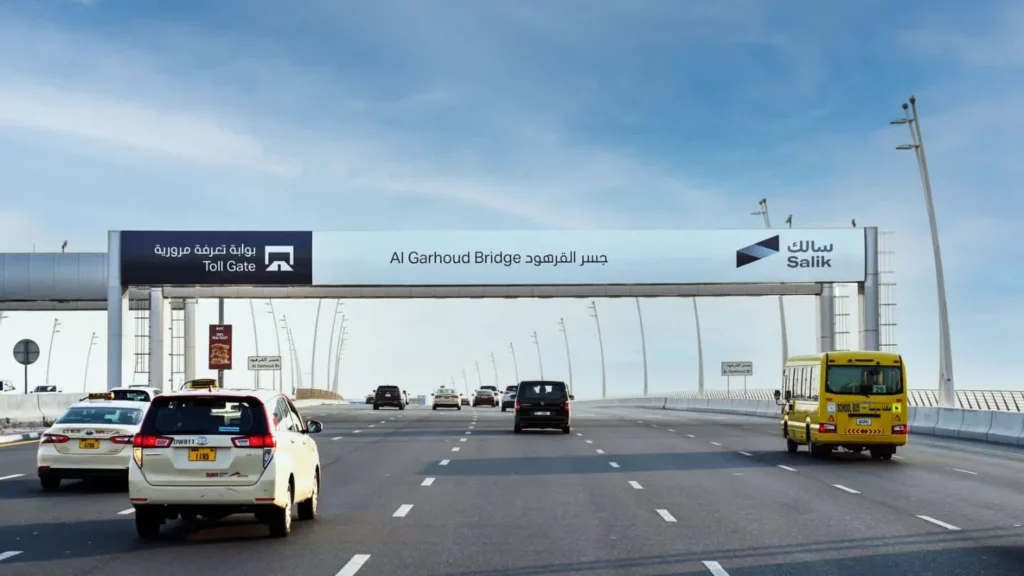
The Salik toll system explained simply
Salik is a free-flow toll system, with no physical barriers to slow you down. Your hire car already has a badge on the windscreen. Each time you pass through a gantry automatically triggers electronic invoicing. You never stop.
Please note, pricing changed at the beginning of 2025. From now on, expect to pay AED 6 at peak times and AED 4 the rest of the time. At night, between 1am and 6am, it's free.
The rental agency manages the balance for you. It will will simply rebill the accumulated total when the vehicle is returned.
Parking in Dubai: the different zones and rates
Le paid parking in almost all the city's commercial and residential areas. The RTA Dubai is divided into coded zones (A, B, C) with highly variable rates. The closer you are to the centre, the higher the hourly rate.
Good news for your wallet: parking is generally free on Sundays and public holidays. It's the perfect time to explore the business districts without stress.
Huge shopping centres such as the Dubai Mall often offer 4 hours free. Make the most of it, because elsewhere the clock is ticking fast.
How to pay for parking: pay and display machines, app and text messaging
The classic method is still the orange parking meter, which still accepts coins. Frankly, it's not not the most practical option under 40 degrees. Nobody carries enough change.
Go straight to the modern method: the RTA Dubai application. It allows you to pay instantly and extend your term remotely without running to the car. This is one of the essential applications in the Emirates for all smart drivers.
If you have a local SIM card, payment by SMS to 7275 is a formidable force. You will receive immediate confirmation.
Parking fines: not to be taken lightly
Don't be fooled, as checks are frequent and ruthless in Dubai. A fine for non-payment is imposed very quickly, often starting at AED 150. Officers scan licence plates electronically. This is a stupid and avoidable waste of money.
The worst thing is not the fine itself, but the associated costs. The rental agency receives the fine, pays it, and then charges it back to you with a salty administrative commission. So you pay double for simple negligence.
Car insurance: what you need to check before signing up
We've talked about costs and rules, but we haven't yet tackled the real safety net: insurance. It's often a dry subject, but understanding it well can save you a lot of financial trouble.
Included basic insurance (CDW) and its limits
Almost all rental contracts include CDW as standard. This is the minimum cover required to take to the road legally. It covers material damage to the vehicle. But be careful, it's not total protection.
The real trap lies in the excess, which is very high. In the event of an at-fault accident, you will have to pay up to AED 3,000 out of pocket. This is a immediate dry loss which many tenants are unaware of. The insurance only starts to pay above this maximum amount.
Supplementary insurance (SCDW) and zero excess«
To avoid this financial risk, there is the Super CDW (SCDW) option. This additional guarantee allows you to reduce or cancel the deductible. If anything goes wrong, you don't have to take anything out of your pocket. It's the only real peace-of-mind option.
Expect the agency to insist on it at the counter. The daily cost is high and can sometimes double the rental price. It's a calculation you have to make.
My opinion is clear: for a short stay, take it without hesitation. Avoiding the stress of a scratch is well worth the extra cost.
Is insuring your bankcard a bad idea?
Gold and Premier cardholders often think they are automatically covered. This is an interesting way of saving on the day-to-day costs of the hire company. On paper, your bank acts as an efficient secondary insurer. Check your ceilings.
But be aware of the reality on the ground: you must have paid for the entire rental with this card. Above all, in the event of an accident, you must bring the franchise to the agency immediately. Repayment by your bank will take weeks. You've been warned.
What is never covered: exclusions to be aware of
Even with comprehensive insurance, certain elements are systematically excluded. Tyres, rims, windows, underbody and roof are not covered. A simple puncture or impact to the windscreen will be charged at full price.
You should also be aware that driving off-road in the desert instantly cancels all your cover. Similarly, driving under the influence of alcohol or being grossly negligent exposes you completely. In such cases, you will pay for all repairs.
Long-term rental and leasing: an option for expatriates?
Renting by the month: flexibility for setting up home
Just arrived? Forget about buying straight away. Monthly rental remains the winning strategy for your first few months as an expatriate in Dubai. It offers immediate mobility without handcuffing you to a credit or a brutal depreciation from the outset.
It's a turnkey solution. These renewable contracts systematically include insurance, maintenance and assistance. You've already got enough paperwork with your visa and your company; ; this all-in-one formula frees your mind. It may be a little more expensive, but tranquillity is priceless at the start.
Leasing: advantages and constraints over 1 to 3 years
If you know you're staying, stop throwing money away on short-term rentals. Commit to 12, 24 or 36 months drastically reduces your monthly bill compared with traditional monthly rental.
The big plus? You drive a new or very recent model for a fixed rent, no budget surprises. It's clean, crisp and predictable for your cash flow.
Beware of the other side of the coin. Breaking a leasing contract early costs a fortune in penalties. Be absolutely sure of your time horizon.
Leasing vs buying: the calculation for an expatriate
Buying a car here means managing a substantial deposit, taking out a car loan, and looking after insurance, maintenance and, above all, resale yourself. It's heavy, Especially if the second-hand market fluctuates during your stay.
Leasing sweeps these frictions under the carpet. For an entrepreneur with an uncertain length of stay, it's often the simplest and safest solution. You pay for the use, not the ownership, which means you don't have to worry about the cost. avoids losing feathers on resale.
Specific documents for a long-term contract
Don't turn up with your hands in your pockets. Unlike tourist rentals, leasing requires solid guarantees your residence visa, your Emirates ID and proof of salary or bank statements to prove your solvency.
You should also be prepared for a local speciality: post-dated cheques. Many agencies still require them to secure monthly payments in advance. This is a common practice in Dubai, and one you should be aware of. accept to access the best rates.
Exploring beyond Dubai: rules for leaving the city
Above all, owning a car gives you the freedom to get off the beaten track. But Can you go anywhere with a hire car?
Driving to Abu Dhabi, Sharjah and the other emirates
Think you're restricted to Dubai? No. Your rental contract generally opens the doors to the seven emirates without any administrative restrictions. The road network is impeccable, linking the cities with disconcerting fluidity. It's the total freedom for your business meetings or getaways.
Beware, however, of the costly Abu Dhabi trap. Unlike Dubai, which often tolerates a margin, the capital applies a strict zero tolerance. If the sign indicates 140 km/h, driving at 141 km/h immediately triggers the flashing light and the fine. So be careful.
Crossing the border into Oman: what you need to know
Here's a mistake 80 % of tourists make: thinking you can just pop off to Musandam on a whim. Forget it. The vast majority of basic contracts strictly prohibit crossing borders of the United Arab Emirates.
Do you really want to see Oman? You need to negotiate before signing. Only a few agencies agree to issue a written authorisation (NOC) and the specific insurance required for Omani territory. This is a paying option, often expensive, and cannot be improvised at the last minute. Without this official document, customs will stop you dead in your tracks.
Desert adventure: precautions to take
The desert may seem like the ideal playground, but for your insurer it's a nightmare. Let's be clear: off-road driving is almost systematically excluded from standard insurance policies. In the event of a mishap in the dunes, you will pay the full amount of the damage.
If you find a specialist agency that hires out fully-equipped 4×4s, never go off on your own. This is a survival rule, not a suggestion. Join an organised convoy, take water, a satellite phone and learn how to manage your tyre pressure.
Planning your road trip: GPS, fuel and range
Don't waste your money on rental companies' GPS options. Waze and Google Maps remain far superior to avoid traffic jams or find your way around. They are more responsive and, above all, free of charge, unlike on-board systems which are often obsolete and have to be paid for.
As for petrol, the network is dense, but caution is still called for. As soon as you leave the main roads for more remote areas, fill up. Running out of fuel in 40 degree weather is not the experience you're looking for.
Vehicle collection and return: the key stages
The adventure begins and ends at the agency counter. Here's how it works managing the handling and return of the car to avoid unpleasant last-minute surprises.
Inspecting the vehicle on recovery: don't let anything slip through the net
This is the most important step in protecting your bank guarantee. Above all, don't botch it. your money at stake.
- Take the full tour: Note the slightest scratch, dent or scrape on the vehicle condition sheet.
- Take photos: Use your smartphone to take detailed photos of the exterior and interior, targeting existing damage.
- Check tyres Make sure they are in good condition and at the right pressure before you leave.
- Check the interior : Report any stains or tears on the seats to avoid cleaning costs.
If the agent is rushing you, insist on taking all the time you need. Those ten minutes of attention can make you save hundreds of euros in deductions.
Fuel policy: «full to full», the golden rule
The most common and fairest policy is «full to the brim». You pick up the car with a full tank. You simply return it with a full tank. This is the the most transparent method for your portfolio.
If you don't, the agency will will invoice for the missing fuel. The rate applied will be much higher than the actual price at the pump. Administrative costs are often added. It's an easy waste of money to avoid.
Renting a car in Dubai offers essential freedom for business or pleasure, but it's not something you can improvise. Between the strategic choice of insurance, vigilance about hidden costs and strict compliance with the highway code, rigorous preparation is the key. Drive with peace of mind while keeping your budget under control. take full advantage of the opportunities the Emirates have to offer.
Faq Rent a car in Dubai
Is it really worth hiring a car in Dubai?
Absolutely, especially if you value your autonomy and your time. Although taxis and VTCs are plentiful, car hire offers total freedom to explore the various business districts, the beaches or get to Abu Dhabi without any time constraints. The road network is excellent and fuel remains cheaper than in Europe, making it a financially viable option for medium-term stays or for expatriates who are just settling in.
What is the budget for car hire in Dubai?
The range is highly segmented. For an economical city car, expect to pay between AED 60 and AED 120 per day. If you're aiming for the luxury segment or a large SUV, rates generally start at AED 500 per day and can go much higher. For residents or longer stays, monthly rental is the most rational option, with rates ranging from AED 1,500 to 2,500 for a standard vehicle, including basic maintenance and insurance.
What driving licence do I need to hire a vehicle?
This depends strictly on your status. Tourists can hire cars with their valid national driving licence (the French licence is accepted), although the International Driving Permit (IDP) is strongly recommended to secure the transaction with all agencies. However, if you are a resident (Emirates ID holder), it is illegal to use a foreign licence: you must have an Emirati driving licence.
Where is the best place to hire a car: the airport or the city centre?
For immediate efficiency, the airport (DXB) is ideal with counters open 24/7, but expect slightly higher fares due to airport taxes. For optimise your budget, However, agencies located in the city (particularly near Deira or via local applications) often offer more competitive prices. In this case, give preference to reputable names or check the reviews carefully to avoid unpleasant surprises about the condition of the vehicle.
Can I drive with a French licence in Dubai?
Yes, but only for tourist purposes. France is one of the countries whose national permit is recognised by the UAE authorities for short-term rentals. However, as soon as you obtain your residence visa, your French licence is no longer valid. You will then have to trade it in or take out a local licence to remain legal.