Key points to remember: property investment in Dubai offers a unique opportunity combining no tax on income and high asset value creation. This strategy makes it possible to secure assets in a stable economy while maximising net profits. With gross rental yields ranging from 6 % to 10 %, the Emirati market clearly outperforms current European standards.
Faced with the uncertainty of the European markets, how can you secure your assets over the long term while avoiding a tax burden that is drastically reducing your net profits? This article takes a methodical look at why you should invest in property investment in Dubai is the ideal strategic alternative for demanding entrepreneurs looking for stability and high performance. Here you'll find figures on the growth districts of 2026, as well as practical tax levers to guarantee rental income net of tax of between 6 % and 10 %.
Forget the idea that this market is just a fleeting Instagram trend. Dubai has a structural solidity that is the envy of many Western capitals today. We are talking here about sustained growth capable of withstanding global economic shocks.
Look at the facts: residential prices jumped by 7.4 % over 2023 alone. Transaction volumes are not stagnating either, with an increase of 15 % over the same period. Experts expect this upward trajectory will be firmly maintained.
This is not a speculative bubble ready to burst. This is the the direct result of a clear, controlled economic strategy.
Many people still think that oil rules everything here, but that's an outdated myth. Real estate growth is based on diversified, robust economy thanks to tourism, finance and technology.
You have assets like the port of Jebel Ali and massive airport expansions. These modern infrastructures are not just decoration. strengthen the city's logistical position. This constant development attracts the companies and talent that the market needs.
This pro-business environment acts as a powerful magnet for international investors. This influx of capital mechanically supports property demand.
Let's talk about what really counts for your portfolio: cash flow. A property investment in Dubai offers some of the best-performing rental returns on a global scale. It's mathematically more profitable.
We are not talking about meagre percentages. gross yields often vary between 6% and 10% per year. Obviously, this fluctuates if you choose a villa on the Palm or a studio in JVC. But the floor remains incredibly high.
Compare that to the 3 %s you struggle to get in European capitals. The profitability gap is indisputable.
It is not true that you have to be a multimillionaire to enter this market. There are accessible entry points that allow first-time investors to position themselves intelligently.
In practical terms, you can securing a property from around €150,000 (around AED 760,000). This budget gives you access to studios or flats in high-potential areas such as Dubai South. It's a reasonable entry ticket.
What's more, developers often offer staggered payment plans. This makes home ownership much easier without tying up all your cash.
Dubai has a golden rule when it comes to property investment. There is no no tax on property income for homeowners.
This logic extends to resale. If you sell your property, the State deducts nothing. Resale of a property is not taxed.
In concrete terms, rental income and capital gains are net of tax in the United Arab Emirates. This directly maximises the investor's return. This is a brutal mathematical difference with Europe.
If you live in France, things are different. The law is strict. Emirati property income must be declared in France. This is an unavoidable legal obligation for all tax residents.
Fortunately, the France-EU tax treaty avoids double taxation. You benefit from a tax credit equal to the French tax. This mechanism cancels taxation in France on this income. So your gross profitability remains protected.
There is, however, one major caveat. However, social security contributions (17.2%) remain due.
To eliminate this friction, there is an alternative. You can aim for a total tax optimisation. All you have to do is become a tax resident in Dubai.
Once expatriated, you are no longer taxable in France on your worldwide income. This includes the rental income from your property in Dubai. This is the principle of tax territoriality. You actually receive 100% of the gains.
This means complying with strict criteria to establish its tax residence in Dubai. Support is often needed in this area.
Don't overlook this point. For French tax residents, property held in Dubai is included in the IFI base in France. The French administration does not forget your foreign assets. The calculation includes all your worldwide assets.
The situation is completely reversed for expatriates. For a non-resident of France for tax purposes, only assets located in France are subject to the IFI. Property in Dubai is therefore exempt..
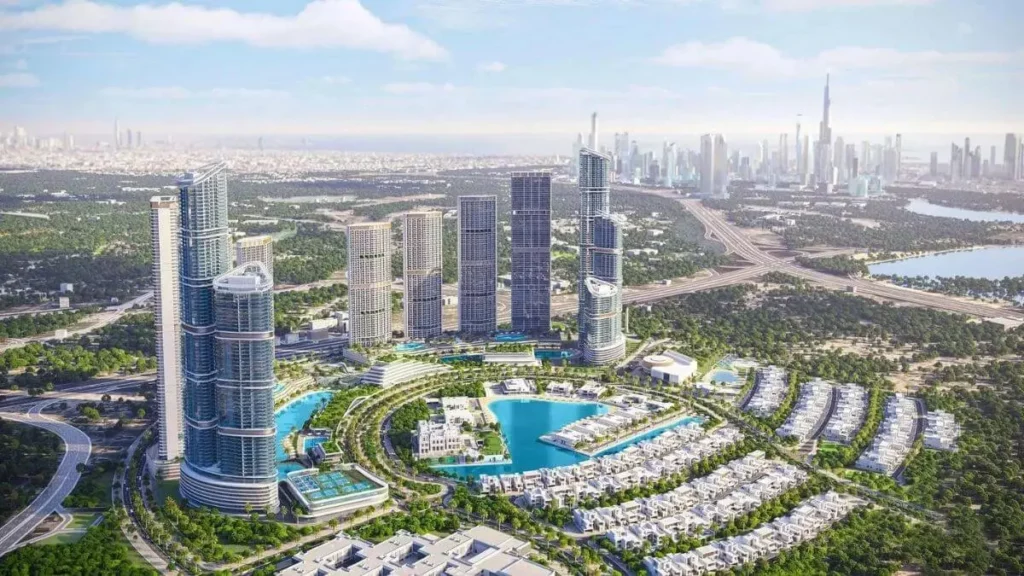
Now that the tax situation is clearer, the question becomes a practical one: where to buy? Each district of Dubai has its own identity and its own investor profile. Here is a overview of the most strategic areas.
Downtown Dubai embodies the a global showcase for luxury, the place to be seen. With the Burj Khalifa, the aim is pure prestige and mass tourism. It's the ultimate trophy investment.
Right next door, Business Bay is the economic engine that never sleeps. This business district massively attracts young dynamic executives and expatriate professionals. Rental demand is constant. It's a pragmatic bet on real business.
Here, you're clearly banking on a solid long-term asset enhancement. We are targeting a demanding clientele who pay a high price.
Dubai Marina remains the favourite playground of Western expatriates for its unique atmosphere. From yachts to trendy restaurants, the quality of life is incomparable. It's a sure thing on the market.
The Palm Jumeirah is in a league of its own with its status as a global icon. Its sea-view flats attract the ultra-rich, guaranteeing total exclusivity. The scarcity of land keeps prices very high. This is the luxury summit.
These areas are cash machines for Airbnb-style holiday rentals. Visit yields are exploding during the high tourist season.
For a successful property investment in Dubai, Jumeirah Village Circle (JVC) is currently unbeatable. It is the number one choice for optimise the ratio between the entry price and the rent received.
Its success is based on much lower entrance fees than in the centre. Families and young couples flock here for the low rents and parkland. Vacancies are virtually non-existent. The returns are often spectacular.
Dubai Sports City offers a similar dynamic, attracting those who prefer an active lifestyle. Visit prices are still very attractive.
It's not easy to find your way around, so let's simplify decision-making with clear data. This table summarising where to invest your money according to your specific financial objectives. Look at the figures, they speak for themselves.
| Neighbourhood | Average price of a flat | Investor profile | Rental yield potential |
|---|---|---|---|
| Downtown Dubai | ~800,000 USD | Prestige, long-term value | Medium to high |
| Dubai Marina | ~700,000 USD | Lifestyle, short-term rental | High |
| Palm Jumeirah | ~1 200 000 USD | Luxury, very high-end customers | Very high |
| Jumeirah Village Circle (JVC) | ~400 000 USD | First-time investor, rental yield | Very high |
| Business Bay | ~600 000 USD | Professionals, long-term rental | High |
Our advice: centre or yield. If you want a premium address and high-end demand, aim for Downtown, Marina or Business Bay. If you're looking for the best rent/price ratio, JVC remains the most cost-effective choice.
Have you spotted the perfect neighbourhood? Yes, perfect. Now it's time to get down to business. Although the Dubai system is renowned for its speed, it remains highly regulated. For a foreign investor, understanding local mechanics is the only way to avoid costly missteps.
Forget the legal complications of pre-2002. Today, everything hinges on a simple but vital concept: freehold zones. This is the condition sine qua non for a foreigner to own 100 % of their property, including the walls and land, for an unlimited period. Outside these areas, you would only be a long-term tenant, which would radically change the value of your asset.
Rest assured, the government has done everything right. Almost all the popular areas for property investment in Dubai, such as the Marina, Downtown and the Palm, are classified as Freehold. In other words, where there is rental potential, you have the green light to become a full owner.
Dubai leaves no room for improvisation. The acquisition process follows a strict protocol overseen by the authorities, designed to secure foreign capital. This is the Exact steps to lock in your investment :
In contrast to the cumbersome French bureaucracy, Dubai plays the efficiency card. For non-residents, a valid passport is often the only key document required on departure. Sometimes, a simple proof of address is added to the file, but this is not always enough. the barrier to entry remains deliberately low to smooth the flow of capital.
However, don't expect to manage everything in cash. You must open a bank account in Dubai. This is essential if you are to pay your co-ownership charges, pay utilities and, above all, receive your rent without friction.
Finally, think beyond the single brick. A substantial investment (generally in excess of AED 2 million) can make you eligible for the Golden Visa Dubai. This sesame offers a 10-year residency, a major strategic asset for your international mobility.
Going it alone in this jungle? Not a good idea. To keep your money safe, you need to go through a RERA-certified estate agent (Real Estate Regulatory Agency). This certification is not an option; it is a guarantee that the person you are dealing with knows the law and is professionally responsible.
But buying is only one step. A specialist partner like Clemenceau Group doesn't just find the property. We coordinate the tax arrangements and administrative procedures for transform a simple acquisition into an optimised, long-term asset.
Our advice: never buy outside the Freehold zone and follow the DLD process to the letter (Booking Form, SPA, NOC, transfer, Title Deed). With a RERA-certified agent, you can avoid 90 % costly mistakes.
Forget the preconceived notion that Dubai is exclusively a cash market. Although cash is king, this is by no means the only way to structure a smart Dubai property investment today.
Let's be specific about current banking requirements. For an investor living abroad, the bank requires a standard risk guarantee. An initial contribution of around 20% of the price of the property is generally the minimum required by institutions.
Watch your cash flow, because this percentage only covers bricks. It never includes ancillary costs such as DLD or agency fees.
Contrary to what many people think, it is completely possible for non-residents to obtain a mortgage with an Emirates bank. Institutions such as Emirates NBD handle these cases on a daily basis.
The cost of money remains competitive compared with Europe. For the period 2025/2026, mortgage interest rates are generally between 3.5% and 4.5% for non-residents, often indexed to the EIBOR.
But that doesn't mean it's automatic. The banks analyse your overall financial situation, This is exactly what a banker would do in France.
If banking constraints are holding you back, buying off-plan is a great way to save money. a very popular financing alternative in Dubai. This is a powerful lever for entering the market without tying up all your capital.
The mechanism is based on promoter payment plans, which are often highly flexible. The buyer pays for the property by instalments, These are often spread over several years of construction, and sometimes even long after the property has been delivered.
This method allows you to smooth out the financial effort over time. You avoid bank interest and the administrative burden of a traditional loan.
The classic beginner's mistake is to underestimate the closing costs that impact on profitability. The biggest item is DLD transfer costs, which must amount to 4% of the purchase price.
Add to this the agency fee (usually 2%), the trustee registration fee and the bank administration fee if you are borrowing. A budget of 7-8% on top of the price is a good estimate so as not to be caught off guard.

Buying is done. Now, how do you ensure that the property will earn you money? Visit choice of rental strategy is as important as the choice of property itself.
Are you aiming for pure performance? Short-term rental is your most powerful lever, especially if you're targeting Palm Jumeirah or the Marina. With gross yields of up to 13 %, This is mathematically superior, but it requires almost hotel-like management.
Conversely, long-term leasing is the choice of absolute peace of mind for the remote investor. You secure a stable yield between 6 % and 7.5 % with tenants who stay put. Here, there is no winter break and the occupier pays the agency fees.
Your final decision will depend solely on your appetite for risk and the time you wish to devote to it.
Let's be clear: you don't need to live there at all in order to making a success of your property investment in Dubai. Distance is no longer a technical or administrative obstacle.
The solution lies in local property management agencies that manage your assets from A to Z. These professionals manage the entries, exits, maintenance and make sure that your rent arrives on your account.
It's a cost that has to be factored in, of course, but it's the price you pay for transforming your property into a real passive income.
The rental market in Dubai is extremely tight, driven by a constant flow of expatriates looking for quick accommodation. In the most sought-after areas, the rental vacancies are virtually non-existent.
The payment system is clearly in your favour: rents are often paid by post-dated cheques covering the whole year. You cash your money in advance, which totally secures your cash flow.
To refine your calculations, please check the rental prices in Dubai neighbourhood by neighbourhood.
Good to know: In Dubai, rents are frequently paid by post-dated cheques for the year, which makes your cash flow much more secure.
Before you sign, take off your rose-coloured glasses. Here are the four technical pillars that can undermine your profitability if you ignore them at the time of purchase.
Investing in Dubai represents a major strategic opportunity to diversify your assets, thanks to attractive tax treatment and high yields. However, this dynamic market does not tolerate improvisation. A clear analysis of the risks and expert support are essential for secure your capital and maximise your profitability over the long term.
Investing in Dubai offers a rare combination of asset security and financial performance. The market is characterised by zero tax on rental income and capital gains for individuals, coupled with sustained growth (+7.4 % on residential prices in 2023). This is an effective diversification strategy for exiting the eurozone and benefiting from a stable dollar economy.
Moreover, rental demand is structural, driven by the constant influx of expatriates and international talent attracted by the infrastructure and quality of life. Unlike speculative markets, Dubai is built on a solid foundation of solid economic fundamentals, offering long-term value prospects for your wallet.
Dubai is ahead of many Western capitals thanks to its unrivalled yield/tax ratio. Where European real estate suffers from heavy taxation and yields often below 4 %, Dubai offers high net returns in a secure pro-business environment. Landlords are well protected and non-payment of rent is virtually non-existent.
The emirate's appeal is further enhanced by schemes such as the Golden Visa, which combines property investment with long-term residence. This legal framework, combined with simplified management - even remotely via specialist agencies - makes the emirate an attractive place to invest. top destination for investors seeking to maximise their cash flow without the usual administrative constraints.
The rental yields in Dubai are among the highest in the world in the world, typically between 6 % and 10 % gross depending on the strategy adopted. Affordable« neighbourhoods such as Jumeirah Village Circle (JVC) or Dubai Sports City often offer the best yields, up to 8 % to 9 %, because the purchase price is moderate compared with the rent.
Premium zones such as Downtown or Palm Jumeirah are more likely to be around 5 % to 6 %, but offer a better prospects for increasing the value of your assets. Note that short-term (seasonal) lettings can often boost these figures by a further 2 to 3 points, provided that the vacancy is properly managed.
If you opt for bank finance in Dubai, banks generally require non-residents to make a minimum downpayment of 20 % of the value of the property, to which must be added around 7 to 8 % in ancillary costs (DLD, agency, bank charges). The the entry ticket for a credible investment starts at around €150,000 (approximately AED 760,000).
However, buying off-plan allows you to bypass traditional bank credit thanks to promoter payment plans. In this case, you can secure a property with a deposit of between 10 % and 20 % on signing, with the balance spread over several years without interest, which considerably reduces the initial cash outlay.

Avoid the mistakes that block a project. Documents, criteria, actual costs, deadlines, procedures and practical advice: it's all here. Download the guide and secure your home.
✨ GUIDE TO INVESTING IN DUBAI
Do you have any questions about investing in Dubai?
Here you will find our additional articles on everything you need to know about living in Dubai: visa types, eligibility requirements, documents, costs, deadlines, renewals and mistakes to avoid.

Download the guide
Download the free guide and prepare your expatriation to Dubai with a clear, step-by-step method.
"*" indicates required fields