Key takeaway: Successfully setting up a business in Dubai depends on choosing between Freezone and Mainland, two structures that now allow 100% foreign ownership. This strategic choice defines the commercial scope and liability for the new 9% tax, with an administrative entry fee of between AED 6,000 and AED 20,000 depending on the jurisdiction chosen.
You're probably wondering how to set up a company in Dubai without getting lost in the local administrative maze or risking costly penalties. This practical guide details each step of the process, from strategic arbitration between Freezone and Mainland to managing new tax realities such as Corporate Tax. Get ready to master the rules of the game to launch your business in the Emirates quickly and confidently, avoiding the pitfalls that await ill-informed entrepreneurs.
For most foreign entrepreneurs, a Freezone company is the logical first choice. It is an option that guarantees 100% foreign ownership while offering administrative simplicity that you won't find anywhere else. You avoid bureaucratic red tape so you can focus on what matters most.
This status clearly targets specific sectors: consulting, technology, and international e-commerce. But beware, there is one major obstacle to anticipate: you will not be able to trade directly on the local Emirati market without going through a third-party distributor. This is a strict legal barrier.
In short, this is the fastest structure to set up if your business model does not depend on customers physically based in the Emirates.
If your ambition is to reach the entire country without barriers, Mainland is the only serious option. It gives you direct and unlimited access to the entire UAE market, without any intermediaries.
The situation has changed: local sponsorship is no longer mandatory, finally allowing 100% foreign ownership for the vast majority of commercial activities. This structure offers much greater credibility with banks and local government institutions, which are often wary of free trade zones.
However, don't underestimate the investment: start-up costs are higher and administrative procedures remain more cumbersome than in a Freezone.
Let's be clear about offshore structures: they are an option to be avoided in 2025. With the drastic tightening of AML/CFT (anti-money laundering) standards, opening a bank account has become a nightmare, not to mention the total absence of residence visas.
Freelancing may seem appealing as a way to start small, but its limitations will quickly catch up with you: low credibility with large clients and the legal inability to hire staff. It's a solution for solopreneurs, not for building an empire.
That said, for certain very specific solo activities, you can check out freelance status in Dubai, which remains a viable gateway before moving on to a real company.
This table helps you visualize the fundamental differences so you don't take the wrong path. We make it easy for you to make the right choice.
| Criteria | Freezone company | Mainland Company | Freelance Status |
|---|---|---|---|
| Property | 100% foreign | 100% foreign (for most activities) | N/A (individual) |
| Market access | International and UAE via distributor | Full access to the UAE market | Local and international (services) |
| Creation cost | Moderate (from AED 6,000) | High (from AED 12,000) | Low |
| Residence visa | Yes | Yes | Yes |
| Ideal for... | E-commerce, consulting, international trading | Local commerce, catering, construction | Consultants, coaches, creative professionals |
Your final choice depends entirely on the nature of your project and your ambitions. It's up to you!
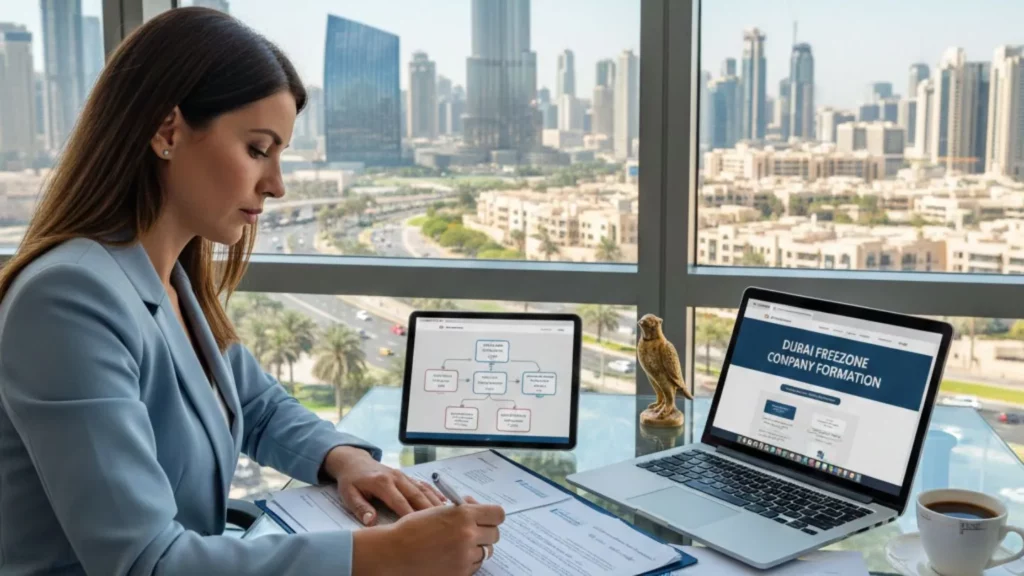
Once you have chosen the structure, the path becomes clearer. Let's now take a look at how to actually set up your business in Dubai.
It all starts with a precise definition of your business activities. This strategic choice will determine the type of license required and sometimes even the most suitable free zone for setting up a company in Dubai.
Want to avoid administrative delays? Careful preparation of your documents in advance remains the absolute key to ensuring a smooth process.
Your complete file is then submitted to the relevant authority. This is done either with the authority of the chosen free zone or with the DED (Dubai Department of Economic Development) for a Mainland company.
Let's move on to choosing a trade name. It is essential to propose several options. The name must comply with certain strict rules, such as the absence of offensive terms or religious references, and must be formally approved by the authorities.
After approving the name and your activities, the authorities will issue an invoice for the license fees. This is the signal that your application has been approved.
Once payment has been made, the commercial license is issued. This is the official document that legally authorizes you to operate in the market.
For a Freezone, this process is quick and can take between 5 and 10 business days if the application is complete.
Please note that obtaining a license is not the end of the process. Rather, it is the real beginning of the start-up phase of the business.
Here are the next steps: visa application, obtaining an Emirates ID, and opening a bank account. Follow the post-creation steps to become fully operational.
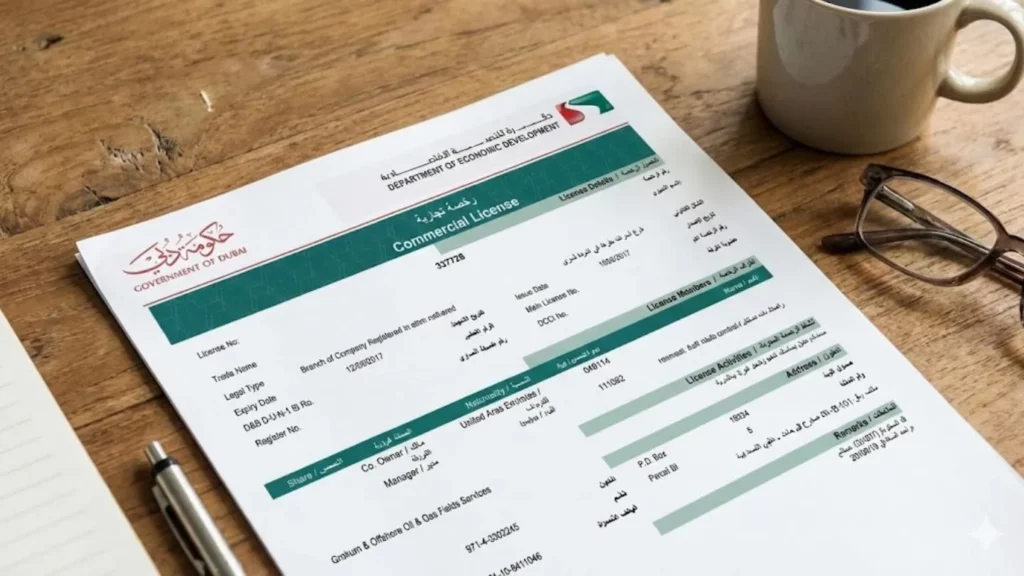
Now that the framework of your project has been defined, let's talk about the element that will bring it to life: the commercial license.
Many people think that all you need to do to set up a company in Dubai is register. This is a mistake. A business license is not just a standard administrative document. It is the key that legally authorizes you to operate, and the type of license you need depends entirely on the nature of your business.
Are you involved in trading, purchasing, or reselling goods? Then you will need a commercial license. This is the most common type of license for traditional trading activities.
If your added value is based on intellectual skills or expertise, opt for the Professional License. It is specifically aimed at consultants, artisans, and liberal professions.
For those who manufacture, assemble , or process raw materials, an Industrial License is mandatory. It is required for any production or assembly activity on Emirati soil.
Please note that certain regulated sectors require specific licenses. This is the case for tourism licenses and e-commerce licenses, which are essential for operating legally in these fields.
Choosing the right license is a technical step where mistakes can be costly. Choosing the wrong category can result in being unable to practice or heavy fines. Here, the expertise of an advisor can help you avoid many pitfalls.
The application process varies depending on your jurisdiction. In Freezone, you deal with the zone authority. For Mainland, the Department of Economic Development (DED) in Dubai handles everything.
After submitting your documents and business plan, an approval phase begins. The authorities carefully check that your project complies with local regulations before giving their approval.
Once approval has been granted and payment has been made, the official document is finally issued. Your company now legally exists. You can now invoice and operate with complete peace of mind.
With your degree in hand, one question remains: how much is all this going to cost? Let's be clear and talk numbers.
Let's address the unpleasant but necessary topic. If you opt to set up a business in the Free Zone, the average budget is between AED 6,000 and AED 15,000. This amount generally includes the license itself and the administrative registration fees required to get started.
The situation changes if you are targeting the local market. To set up a business in Mainland, you will need a larger budget, ranging from AED 12,000 to AED 20,000. The entry fee is higher, but that is the price of direct access to the Emirati market.
Be wary of discount offers flooding the web. An unusually low price often hides additional costs or incomplete services that will cost you more later on. Transparency on pricing is your best indicator of reliability.
It is a common mistake to think that the expense ends with the creation. You must anticipate the annual renewal costs of your license. This is a fixed cost that must be included in your budget now to avoid unpleasant surprises.
There are other costs to consider. You will need to pay for the renewal of your residence visa every two or three years, as well as the mandatory rental of an office or a flexi-desk.
Finally, tax compliance must not be overlooked when setting up a sustainable company in Dubai. Accounting and reporting fees (VAT, corporate tax) have become standard. These compliance costs protect you from much heavier fines.
Is it really necessary to pay for assistance with these procedures? The answer is yes, without hesitation.
The fees charged by a firm of experts are not simply an expense, but a genuine investment in the security and speed of your project. They are familiar with local subtleties that you are unaware of.
This initial investment saves you valuable time and prevents costly administrative errors. It's the price of priceless peace of mind, allowing you to focus solely on growing your business.
Our advice: Avoid offers that seem too good to be true and focus on the overall budget. Professional support is an investment that secures your project and avoids hidden costs.
Forget the myth of zero taxation that was circulating ten years ago. Dubai has modernized its tax system, and it is vital to understand the new rules of the game to avoid unpleasant financial surprises.
Corporate tax radically changes the local landscape for entrepreneurs. It is a direct tax levied on the profits made by your business. Fortunately, the rate remains frozen at 0% on the first AED 375,000 of annual net profit.
However, it is important to note that for profits exceeding this threshold of AED 375,000, the government now applies a rate of 9%. This percentage only applies to the excess generated. This remains extremely competitive globally.
Make no mistake, all companies, even those in the Free Zone, are affected. You must register with the Federal Tax Authority (FTA). This is a mandatory step in order to set up a company in Dubai in accordance with the law.
VAT is now part of everyday business here. The rate is set at 5% on the vast majority of goods and services sold in the UAE. It is a classic consumption tax.
Here is the golden rule for staying on the right side of the law. VAT registration is mandatory as soon as your company's annual turnover exceeds AED 375,000. Keep a close eye on this figure.
This means collecting VAT from your end customers. You will then need to declare it periodically and pay it to the government. Accurate accounting is therefore essential to avoid penalties.
Don't panic, Dubai's main attraction hasn't disappeared with these reforms. Despite the recent introduction of corporate tax, there is still one major advantage for entrepreneurs. That's what makes all the difference.
There is still no personal income tax in Dubai. The salaries and dividends you pay yourself are completely tax-free. Everything you earn personally remains yours.
This absence of personal income tax remains one of the pillars ofDubai's appeal. It is the number one argument for entrepreneurs around the world. Your personal wealth is thus protected and maximized.
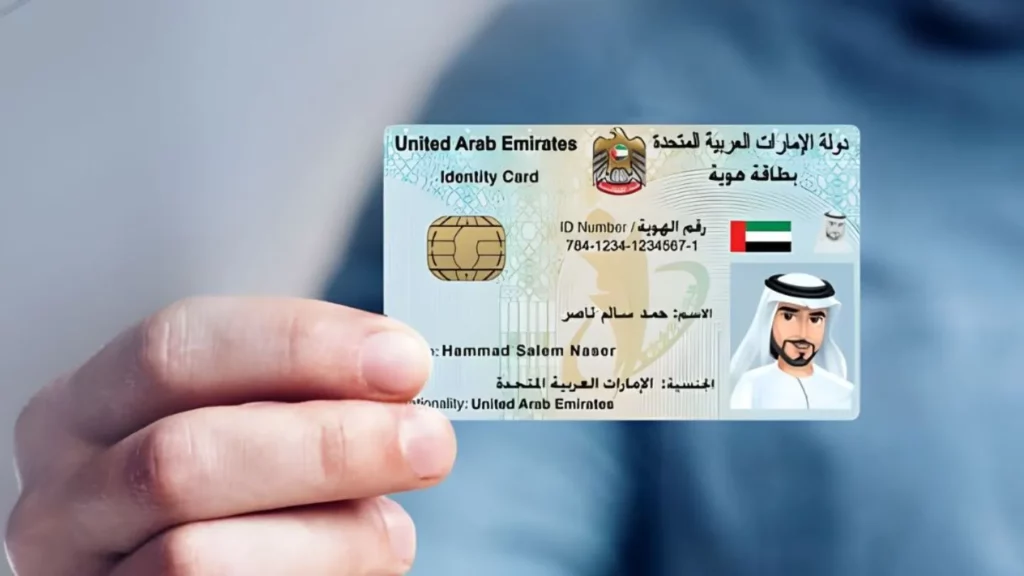
Your structure is registered and the tax framework is in place, but the work is not finished. To actually set up a company in Dubai and operate there, there are still two concrete steps separating you from the final goal.
Having a business license is an absolute prerequisite for obtaining a residence visa. This key document is not automatically obtained after registration; you must explicitly apply for it. This is the crucial step in validating your presence.
This official document is directly linked to your status as an investor or company executive. It legally authorizes you to live in the United Arab Emirates on a long-term basis. Without it, you remain a mere visitor.
To obtain one, you will need to undergo a quick medical examination and have your biometric data collected on site. These formalities will unlock your Emirates ID, the essential local identity card. It is your pass to all services.
Many entrepreneurs think it's just a simple administrative formality, but that's a big mistake. Opening a business bank account has become the most stringent and complex step in Dubai. If you underestimate it, you risk blocking your entire business.
Local banks are subject to particularly stringent compliance rules (KYC/AML) today. They require solid evidence to validate the economic legitimacy of your business. They no longer take any unnecessary risks.
A poorly prepared application or a vaguely defined business activity will almost always lead to rejection. This is where an expert with the right banking connections can make all the difference. Don't go it alone on this one.
Your own residence visa grants you the valuable right to "sponsor" your immediate family. This generally applies to your spouse and children so that they can join you. Family often remains the priority of the project.
It is a separate administrative procedure, but it depends entirely on the validity of your own status. It will enable themto obtain their own residence visa to settle permanently. Everything is linked to your main file.
Please note that minimum income requirements generally apply in order to validate this family sponsorship. This is a critical point to check when planning your expatriation project. Anticipate these criteria to avoid unpleasant surprises.
Many people think that obtaining a license marks the end of the process. Wrong. You must prove the economic substance of your entity. In other words, the authorities want to see real activity in the UAE, not an empty shell or a simple "mailbox."
In practical terms, this requires a physical workspace, even a flexi-desk, local expenses, and employees. Effective management must be carried out from the Emirates in order to validate your structure.
This is not excessive zeal, but a requirement of international standards (OECD) against tax evasion. The Emirati authorities are very attentive to this, so do not overlook this fundamental aspect.
The work does not stop once the license has been obtained; on the contrary, vigilance remains essential.
Failure to comply with these obligations results in heavy financial penalties and may lead to the suspension of the license. You risk a lot for a simple administrative oversight or negligence.
Managing this compliance can quickly become a full-time job for a manager. It is a major source of stress that distracts entrepreneurs from their core business and slows down growth.
The logical solution is to delegate this monitoring to trusted professionals. Firms such as Clemenceaugroup offer accounting, tax monitoring, and legal secretarial services to give you peace of mind.
This is the best way to secure your investment in the long term. You can thus ensure that your plan to set up a company in Dubai remains fully compliant, both now and in the future.
Launching your business in Dubai is an exceptional strategic springboard, provided you understand the rules of the game. Between legal choices and tax compliance, there is no room for improvisation. To turn this project into a lasting success without wasting time, expert support remains your best asset for securing your investment.
The budget varies considerably depending on the legal structure chosen. For a Freezone company, the start-up cost is generally between AED 6,000 and AED 15,000. If you opt for a Mainland company, you should budget between AED 12,000 and AED 20,000. Keep in mind that these amounts cover basic administrative costs; visa and office rental costs often need to be added.
Dubai offers an exceptional business environment with favorable taxation (no personal income tax) and first-class logistics infrastructure. It is a strategic gateway to the markets of the Middle East, Africa, and Asia. In addition, political stability and legal certainty reassure foreign investors.
Since the introduction of the new tax system, a corporate tax rate of 9% applies. However, this tax only applies to profits exceeding AED 375,000 per year. Below this amount, the rate remains at 0%. It is important to note that registration with the tax authority is mandatory for all companies, regardless of their turnover.
Yes, that is entirely possible. In the Free Trade Zones, 100% foreign ownership has long been the norm. With regard to Mainland companies, recent reforms have removed the requirement for a local majority sponsor for most commercial activities, allowing foreign investors to hold 100% of the capital.
The cost of setting up an offshore company is attractive, often between AED 8,000 and AED 15,000. However, this structure is now strongly discouraged for most entrepreneurs. It does not allow you to obtain a residence visa, does not authorize any commercial activity on Emirati soil, and makes opening a business bank account extremely difficult due to anti-money laundering regulations.
Beyond setting up the business, you need to budget for your personal relocation. Allow for around AED 7,000 to 8,000 per residence visa. The cost of living and housing varies depending on the neighborhood, but it is prudent to have a total budget of at least AED 50,000 (approximately €12,500) to cover the creation of the company, visas, and the first few months of rent and operating costs.

Legal structure, license, actual budget, visa, bank account, and pitfalls to avoid. Download the complete guide to setting up your company in Dubai with peace of mind.
✨ GUIDE TO MOVING TO THE UAE
Questions about setting up a company in Dubai?
Find all our guides on setting up a company in Dubai and the United Arab Emirates.
Download guide
Download the guide for free and prepare for your move to Dubai with a clear, step-by-step method.
" * " indicates required fields