Faced with declining real estate margins in the West, securing a high-yield tangible asset has become the top priority for wealth managers. Buying an apartment in Dubai is the optimal tax and financial strategy for capturing gross rental yields often exceeding 8% without incurring any taxation. This technical report breaks down the purchasing mechanisms, hidden costs, and emerging neighborhoods to help you structure a high-performing investment capable of generating positive cash flow from the first year.
Why Dubai is the favorite playground for real estate investors
A rental yield that defies European competition
Let's be clear: gross rental yields in Dubai literally dwarf those found on the Old Continent. While Paris and London often struggle to exceed 3%, certain neighborhoods in Dubai, such as JVC, boast impressive returns of between 7% and 10%. It's simple math. This profitability is no accident; it is fueled by strong and constant rental demand, driven by an army of expatriates and young professionals who arrive every month. And don't limit yourself to traditional leases. Short-term rentals, such as Airbnb, are skyrocketing in tourist areas, offering even more aggressive returns.
Taxation: the emirate's real competitive advantage
Here's the argument that hurts the French tax authorities:the absence of tax on rental income and capital gains on real estate for individuals. In concrete terms, what you earn really ends up in your pocket, not in the state coffers. But beware, "zero tax" does not mean completely free. You will have to pay initial registration fees and annual co-ownership charges, which are the price of admission to this tax haven. To avoid unpleasant surprises, I strongly advise you to consult the tax treaty between France and the UAE. Understanding this framework is the only way to secure your financial arrangement.
A secure real estate market open to foreigners
Forget preconceived notions about the complexity of buying property in the Middle East. In "freehold" areas, you can purchase an apartment in Dubai with full ownership rights, just like in France. The system is regulated by the Dubai Land Department (DLD), which enforces total transparency. If you buy off-plan, your money is protected in an escrow account and is only released as construction progresses. This rigor reassures investors around the world, ensuring excellent market liquidity. Reselling your property will be as smooth as buying it.
The actual budget for purchasing an apartment in Dubai
The purchase price: an extremely wide range
Many people think that the emirate is prohibitively expensive, but this is a misconception. You can find a comfortable studio apartment for around €145,000 in booming neighborhoods such as Dubailand or JVC, making investment accessible even for those on a moderate budget.
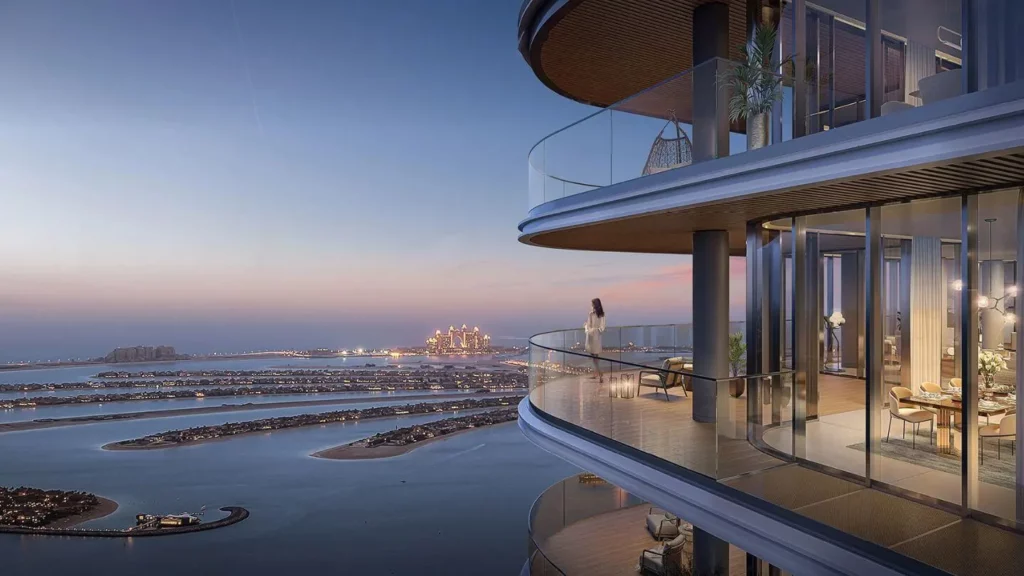
Conversely, if you are aiming for absolute prestige, the price tag quickly rises. Residences located in Business Bay or Palm Jumeirah easily exceed several million euros, illustrating the huge gap between entry-level properties and luxury homes.
Why such a difference? It all comes down to three factors: location, view, and finishes. An apartment in Dubai with a direct view of the Burj Khalifa is simply in a different league from a ground-floor property.
Hidden costs you mustn't forget
Here is the classic mistake that kills profitability: forgetting the check for the government. You must pay the transfer fees to the DLD (Dubai Land Department), which amount to 4% of the property price, an immediate and unavoidable expense.
Add to that the agency commission, often set at 2%, and the administrative fees for obtaining the No Objection Certificate (NOC). These costs add up and can come as a surprise if they are not anticipated.
To avoid running out of cash, set aside a total budget of 7 to 8%. Here are the specific details to include in your forecast:
- DLD fee: 4% of the sale price.
- Administrative fees (Trustee fees): approximately AED 4,000.
- Agency fees: 2% of the sale price (+VAT).
- NOC fees (for secondary school): AED 500 to 5,000.
Annual expenses: anticipating operating costs
Once you become an owner, you will have to pay "service charges."These are mandatory condominium fees that finance the maintenance of common areas such as the swimming pool, gym, security, and cleaning, billed per square foot.
Do not sign anything without checking this figure: these charges generally vary from AED 10 to AED 30 per square foot per year depending on the standard of the building. This is a technical criterion that has a significant impact in the long term.
Why is this vital? Because these costs eat into your net rental yield. High rent is useless if expenses skyrocket. Carefully analyze the cost of living in Dubai to validate the viability of your project.
How to finance your real estate investment in Dubai
The budget is set, but the financing still needs to be defined. Forget the cliché of the briefcase full of cash—it's not necessary. There are several solid options available to foreign investors.
Mortgage loans for non-residents: mission possible
Contrary to persistent rumors, Emirati banks do lend to foreigners. You do not need to be a resident to obtain a mortgage from an Emirati bank. This is a strategy that many people wrongly overlook. The local banking system is, in fact, accessible.
But be careful, the rules of the game are different from what you are used to in Europe. Banks generally finance up to 50-60% of the property price for non-residents. You will therefore need to make a substantial personal contribution to reassure the bank.
To avoid outright rejection, your application must be prepared with military precision. Emirati bankers leave nothing to chance when analyzing applications. Here are the documents required to prove that you are a reliable candidate:
- Valid passport and visitor visa.
- Bank statements for the last 6 months.
- Proof of income (pay slips, tax notices).
- Credit report from their country of origin (credit score).
Developer payment plans: the alternative to bank loans
This is the option that savvy investors are snapping up in the new-build market. Developer payment plans allow you to pay for your Dubai apartment in several installments. You pay the builder directly, without going through the bank. It's simple and effective.
Imagine paying 1% per month or spreading the balance over 3 years after receiving the keys. The big advantage is thatthere is no bank interest whatsoever. It is literally an interest-free loan (zero rate) offered by the developer to facilitate the purchase.
However, this flexibility comes with a risk that you cannot ignore. You are financially tied to the long-term health of the developer. Always check the reputation and financial strength of the developer before signing anything.

The best neighborhoods to buy an apartment in Dubai
Securing financing is one thing, but knowing exactly where to invest your money is another. Each area of Dubai has its own dynamics and attracts a specific type of investor. Here is an overview to help you clarify your strategy.
A comparison of the best neighborhoods for investment
Don't choose your area at random or on a whim. This table summarizes actual data to align your budget with your profitability goals.
| Neighborhood | Entry price (Studio/1 bedroom) | Investor profile | Potential |
|---|---|---|---|
| Jumeirah Village Circle (JVC) | Starting at €160,000 | First-time investor, seeking rental yield | Excellent ROI, strong rental demand. |
| Business Bay | Starting at €450,000 | Premium investor, business expatriate | Close to downtown, strong potential for appreciation. |
| Dubai Marina | Starting at €350,000 | Lifestyle investor, vacation rental | Exceptional living environment, maximum tourist appeal. |
| Dubailand | Starting at $145,000 | Small-budget investor, long-term vision | Very affordable prices, rapidly developing neighborhood. |
| Palm Jumeirah | From €600,000 | Luxury investor, second home | Iconic address, prestige, and exclusivity. |
JVC and Dubailand: champions of value for money
JVC has established itself as a popular family community, offering tranquility and numerous parks. It is the ideal playground for securing stable long-term rentals. Families move there to stay, guaranteeing a high occupancy rate.
Dubailand represents a smart bet on the city's future expansion. With very low admission prices, you are betting on future urban development. Massive theme park projects are boosting the appeal of this up-and-coming area.
These two areas are the ideal starting point for your first apartment in Dubai. You can control your financial exposure while aiming for solid rental returns. It's the pragmatic option for getting started without taking excessive risks.
Business Bay and Downtown: the beating heart of Dubai
Business Bay acts as a natural extension of Downtown, establishing itself as the must-be business district. It is the perfect target for attracting young, dynamic executives who want to live a stone's throw from the office. Demand is structural and rents are following suit.
Downtown remains the epicenter of prestige, with the Burj Khalifa and Dubai Mall as immediate neighbors. Investing here requires a substantial budget, but it attracts an ultra-premium clientele. What you are buying here is a globally recognized address and brand image.
These neighborhoods are safe havens for those who prioritize asset security. The main focus here is on stability and long-term appreciation.
Key steps to finalizing your real estate purchase
Once the neighborhood has been targeted and the financing approved, the purchase process begins. It is a well-oiled machine, much simpler than one might think, as long as the steps are followed.
From research to signing the sales contract
It all starts with precisely targeting your future apartment in Dubai. Only trust a RERA-certified real estate agent to avoid pitfalls. That's your only guarantee of reliability here.
Once the property has been approved, you sign the Memorandum of Understanding, or MOU. This official document seals the agreement between the parties. You then pay a 10% deposit by check. This proves your immediate financial commitment.
This contract definitively locks in the property in your name. It sets out the terms of the sale, just like a preliminary sales agreement. Without this document, the transaction remains volatile.
Obtaining the NOC and transferring ownership
On the secondary market, the next step is mandatory: obtaining the No Objection Certificate (NOC). The developer will only issue this document if the seller is up to date with their charges.
When buying off-plan, you can forget about this administrative formality. The transaction takes place directly between you and the property developer, which streamlines the process. The process is much more straightforward.
The NOC is not just a piece of paper, it is financial security. It guarantees that you will not inherit any debts associated with the property. This means you can invest with complete peace of mind.
The final meeting at the DLD and the handover of keys
The final stage takes place at the Dubai Land Department office. This is the only authority authorized to officially register the transfer of ownership. You must be present to finalize the deed.
It's time to settle up: you pay the balance and the DLD fees. Payment is made by certified bank checks, or "manager's checks." Everything is secured at the moment of payment.
To summarize the procedure and avoid costly mistakes, here is the precise chronological order to follow:
- Signing of the MOU and payment of the deposit.
- Request for NOC (if secondary school).
- Meet at the DLD for the transfer.
- Issuance of the new title deed in the buyer's name.
The buyer then receives their title deed and keys. They are officially the owner and the transaction is complete.
After the purchase: how to optimize your rental investment
Signing the deed of sale is just the beginning. To make your Dubai apartment profitable, you need to pull the right levers and make it work for you.
Long-term or seasonal rental: making the right choice
Long-term rentals (minimum one year) are the most stable option. Rent is often paid in 1 to 4 checks for the year, providing immediate financial visibility.
Short-term rentals are more lucrative but require a lot of management. They are ideal for properties located in tourist areas such as the Marina or Downtown.
Your choice depends on your objective: long-term security and passivity, or maximum profitability with greater involvement?
Rental management: delegate for greater peace of mind
For a non-resident, rental management by an agency is almost essential. They handle everything: finding tenants, collecting rent, and resolving issues.
This service generally costs 5 to 8% of annual rental income. It's a cost to factor in, but it buys you peace of mind from afar.
A good agency is key to ensuring the long-term success of your investment. It also ensures compliance with local laws, saving you from costly penalties.
Exit strategy: consider resale and capital gains
Don't forget the ultimate goal: added value on resale. The Dubai market is cyclical, but the trend remains bullish for quality assets.
Avoid short-term thinking. A solid investment should be judged over a 5- to 10-year horizon to smooth out market cycles.
The absence of capital gains tax makes leaving very attractive. This success can also be a first step before moving to Dubai.
Investing in real estate in Dubai offers a rare combination of high returns and tax optimization. Beyond the immediate financial appeal, it is a strategic investment in a dynamic and secure market. To maximize your ROI, thorough preparation and a long-term vision remain your best assets for a successful acquisition.
Frequently asked questions: How to buy an apartment in Dubai
How much money do you really need to budget for buying an apartment in Dubai?
The entry ticket to the Dubai real estate market is surprisingly affordable compared to major Western cities. For a rental investment such as a studio or small one-bedroom apartment in dynamic neighborhoods such as Jumeirah Village Circle (JVC) or Dubailand, prices start at around €145,000 to €160,000. In contrast, the luxury segment on Palm Jumeirah or Downtown can reach several million euros.
However, as an informed investor, you must factor in additional costs from the outset. Allow for approximately 7 to 8% of the purchase price to cover Dubai Land Department transfer fees (4%), agency fees, and various administrative costs. This is a realistic overall budget that will help you avoid any cash flow surprises.
Why is it more financially attractive to invest in Dubai than in Europe?
The main attraction lies in taxation and net returns. Unlike France and other European countries, Dubai does not levy any tax on rental income or capital gains on real estate for individuals. What you earn is what you keep, once condominium fees have been deducted.
In addition, gross rental yields generally range between 5% and 8%, or even higher for short-term rentals, which is significantly higher than the average for European capitals. This combination of high profitability and zero taxation (0%) automatically maximizes your return on investment (ROI).
In which neighborhoods should you target affordable apartments with high potential?
If your strategy is focused on optimal value for money and a moderate entry price, concentrate on booming areas such as Jumeirah Village Circle (JVC), Dubailand, or Arjan. These neighborhoods offer modern infrastructure and attract a large middle-class expatriate population, ensuring consistent rental demand.
Investing in these sectors allows you to acquire new or recent properties for less than €200,000, while hoping for an attractive capital gain on resale thanks to the continuous development of the surrounding infrastructure.
Is it wise to buy real estate in Dubai in the current climate?
Yes, market fundamentals remain very strong. Government regulation (via the DLD and RERA) ensures transparency and transaction security, which is reassuring for foreign investors, who can own 100% of properties in the "Freehold" zone.
The continuous influx of new residents and entrepreneurs supports rental demand. However, a selective approach is essential: focus on premium locations and proven developers to secure the long-term value of your asset.
Is it really more expensive to buy an apartment in Dubai compared to Paris or London?
On the contrary, for equivalent standards, Dubai is often much more competitive. The price per square meter is generally lower than in Paris or London, while the amenities are superior (swimming pools, gyms, 24-hour security included in the residences).
You therefore get more value for your investment: larger spaces, more luxurious finishes, and modern amenities, all for a purchase price per square foot that is often two to three times lower than in the prestigious neighborhoods of European capitals.